Players will soon be able to sink their claws into Marvel’s Wolverine when it comes to PS5 on September 15. Ahead of its release, we had the chance to meet with part of the creative team behind the claws – Marcus Smith (creative director), Mike Daly (game director), Grant Hollis (senior art director), Brian Wyser (senior animation director), and Walt Williams (narrative director) — to learn more about crafting Wolverine’s final design, choosing which allies, foes and locations to feature, and how they knew they captured Logan’s essence.
PlayStation: Insomniac has built this incredible reputation for comic book adaptations. Your version of Spider-Man, both Miles and Peter, has become iconic in its own way. What was it like to start that process over again for another character?
Marcus Smith: Exciting, honestly. Very exciting. When you have to craft a player experience, it means going back to the drawing board and redefining what the character is, how we can be true to that character. And what we recognized very early on was Peter Parker and Miles Morales are very different than Logan. Every decision that we made after deciding what was key to Logan took us down a different road that deviated from Spider-Man. So, while Spider-Man is an open-world game, he’s so tied to New York, with Wolverine everything is closer, more visceral, more contact with the world, more grounded.
What would you say is essential for designing Wolverine? What did you have to get right?
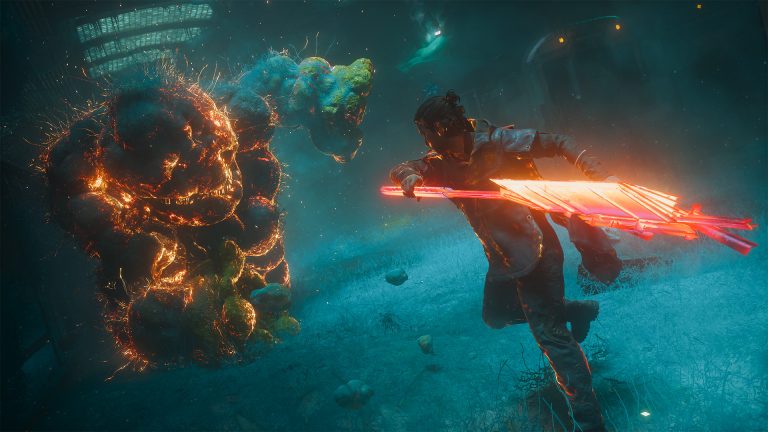
Grant Hollis: The claws, and therefore the combat. He’s a reluctant hero that will get the job done by any means necessary. And so, for us, both in the visuals and in the animation, it was figuring out what does it mean to be Wolverine. From a visual standpoint, we were like, “Okay, Logan is a tank. He’s a little messier, he’s a little clumsier, he’ll break more stuff.” So that was all what we did on the art: blood, destruction, damage. Damage to you, damage to the enemies. Getting all of that was really important.
Walt Williams: One of the great things about working on the story is that we had a fantastic actor, Liam McIntyre, who was our Logan. Crafting our version of Logan through him in lockstep and collaboration was such a key part to this. He has such an amazing range to be able to express the ferocity and the animalistic rage of Logan, but also, he can be such a gentle, kind soul. Which is really, I think, the most interesting thing about this character. There’s such a duality to him. The rage and the anger come from this deep well of emotional feeling.
I thought it was interesting in the [hands on preview], the moments where his rage lets loose seem to be driven by his humanity, where he’s really grounded in his feelings.
Smith: Absolutely. I think it was really important that this is a guy who has been dedicating his life being on Team X to protect mutants, and then seeing that mutants are being treated like science experiments and tossed away. That’s going to have an effect. That’s where he’s going to go crazy, seeing those that he would try to protect, the vulnerable, being completely dominated and thrown out.
Mike Daly: And in a way, that’s a really good illustration of what makes video games so powerful. Because it’s not just a matter of seeing it in a cinematic or seeing it on the screen, but you feel it for yourself. You get pulled into that conflict, and you get to experience that very difficult to control rage for yourself.
Going into his character design building out the [Battle Reborn] suit, did you know that this was the version you were always working towards? Or did you have multiple iterations?
Hollis: With the suit, we knew early on that we wanted two colors. We were fans of the brown and yellow from the 1980s, as well as the yellow and blue with a little hint of red. We knew we wanted [it] to be something inspired from what had come in the past, but put our own spin on it. Because of the more grounded story we were shooting for, and the more lived-in universe, we knew we wanted [it] to have this tactical edge. We wanted it to feel like a suit that somebody could fabricate realistically, that would be based on what maybe a military outfit would be, or some body armor from a motorcycle rider. We took a lot of inspiration from real-world items.
As for the color, pretty much we knew the yellow because it was in those two suits early on. It was just a matter of, what do we want to go with that yellow? We ended up going with a little more black than brown.
When building the story, how did you decide which of Wolverine’s allies and villains to pull from?
Smith: Well, Logan is kind of an introvert. He would be much happier sitting in his cabin, whittling away quietly. So, what was important to us is to put him in a team filled with conflict. Having an emotional, moral compass, a skewed personality conflict, it’s high drama. That’s exciting, we do want to see Logan and Sabretooth really going at it and calling each other names and all of that. Likewise, Mystique has a totally different outlook on life throughout the game that I hope will be surprising to players, fans especially. Then you have Jean Grey, who really taps into this mutual obligation to protect the most vulnerable. Their obligations run parallel, but their approaches and considerations might differ. So that’s really what it comes down to: how do these characters work with and against one another in good ways?
Daly: Yeah, and as far as the other enemies you’ll fight, we knew we needed a force that could believably contend with Logan himself, who obviously is a very dangerous character to deal with. So, the Reavers were a good fit as extremely hyper-lethal cyborg mercenaries who had the equipment, the armor, the endurance, and the manpower to basically face off against Wolverine in a competent way. As well as the Hand, who have expert training in ancient tactics, but also really deadly weapons. They were both good fits that also had a natural place in the story, and we could put them in places where they have an objective that aligns with the story of the mission and pits you against them in a way that makes you feel like you’re making progress towards the story.
Wolverine and Mystique, him and Sabretooth, what was that process of building out their distinct relationship with one another?
Williams: One of the great things about a great Logan story is the sense of mystery, the sense of revelation. We knew that if we simply adapted relationships or arcs or stories that people had seen before, we would be robbing them of that because they would come in already knowing what to expect. Finding new angles on relationships with the characters like Sabretooth, beginning to explore more of their past in Team X, being able to see how these two might have a tumultuous but brother-in-arms type relationship…where is that line? How does it constantly shift from supporting each other to antagonism? Sabretooth is kind of literally the big brother. This is a man who’s about nine feet tall, and so yes, him and Logan have that shared animalistic nature. But at the same time, Sabretooth feels abandoned by Logan.
And with Mystique, this is a woman whose powers allowed her to hide in plain sight for so long until she found Team X and was empowered to be the best her that she could be. And now she travels the world. She doesn’t have to fear for safety. She doesn’t have to fear for her identity. She is getting to live the life of a worldwide soldier, assassin, freedom fighter for mutants, and she’s just loving every minute of it. While Sabretooth and Logan are constantly bickering, she’s getting the job done. Not because she’s the responsible one, but because she actually likes it. She’s having a great time. She’s like, I get to travel the world. I get to meet and kill interesting people. Let’s go! So finding these nuanced, found-family kind of relationships and exploring angles on them that we haven’t really seen before, we knew it was going to be rewarding for players to experience.
How would you say Wolverine’s animation sets him apart from the other characters?
Brian Wyser: Sabretooth is definitely much more of a wrecking ball. He throws caution to the wind and acts first, thinks second. You can see that in his combat as he’s an ally fighting alongside of you. With Wolverine, it’s a journey. We plant a stake in the ground early on in a project on the animation team, where we will do pre-vis examples of what the design team wants. We try and visualize that action in a sequence. I think one of the earliest things we put together was Wolverine fighting in the snow. As we explore, we use those as kind of our tentpole to say, well, some of that’s great, but not this other trait. It becomes a stake in the ground.
With the development of [Wolverine’s] fighting style, we knew from the start that this is a man that is trained in every martial art. We want him to be much more of a brawler and capable of just laying waste to many at once. That became something that was really a trait we focused on for his combat. And the last thing I’ll say, as an animation pillar or goal, we really wanted to bring out the animal in Wolverine. We really wanted to take [his] quadrupedal stride as he’s beginning to run and apply that to traversal as he moves around in the world.
How do you want players to feel when they finish the game?
Williams: I want players to walk away with empathy for what this man has gone through. This is a man who has suffered so much and lost so much, while at the same time brought so much to the people around him. [He] has sacrificed, in many cases, everything in order to make sure that the people he cares about get to see another day. If players walk away with that type of empathy for Logan, not just loving the visceral action of getting to be Wolverine, but feeling sympathy for the man Logan is, then we truly have created and given them the ultimate Wolverine experience.
Experience the combat, rage, and humanity of Marvel’s Wolverine when it comes to PlayStation 5 on September 15.