Rewarded Video Ads in Web Games: 7 Live “Best” Examples
Most guides to rewarded video are written for mobile. They cover SDK mediation, app-store review, and CPMs that don’t apply once the game runs in a browser tab. This post is different. Every example below is a live web game, running rewarded video through AppLixir today, in HTML5, WebGL or Unity Web.
Rewarded video is the only ad format a player chooses to watch. That single fact changes the economics. The player has already agreed to the ad, so the question is not how to force an impression. It is where to put the offer so the player says yes. Placement, not CPM, decides how much rewarded video earns.
The seven games cover the range of the web market: a mid-core RPG, two social casino titles, interactive fiction, a WebGL customization game, an open-source casual hit, and a mobile studio’s browser build. Each one makes a different placement decision, and each decision is a product decision, not an ad-tech one. Watch the clips, then read why each placement works and what it would look like in your game.
Rewarded video is the only ad format players choose to watch, which means placement, not CPM, decides how much it earns. The seven browser games below all run rewarded video through AppLixir, but each makes a different placement decision for a different genre. Watch the clips, then read why each one works.
1. Hero Wars: Dominion Era — mid-core RPG, three placements
What it is: Nexters’ browser version of Hero Wars, running rewarded video in three distinct spots. Part 1 shows a mid-loop placement where a player stuck on a stage is offered a boost or retry. Next part covers the lobby offer. Last part shows the ad experience itself: timer, creative, completion state and hand-back to the game.
Placement logic: Each spot carries its own zone ID, so the studio sees opt-in, completion and revenue per placement rather than one blended figure. Lobby offers catch players with spare time and low urgency; mid-loop offers catch players with intent, and intent drives completion. Part 3 exists because the delivery details — correct sizing, visible timer, muted-by-default, clean return to gameplay — are what keep completion rates high once a player has opted in.
Takeaway: Never report rewarded video as a single number. Instrument every placement separately, compare them, and move the offer to where the data says intent is highest.
2. Royal Lounge — social casino
What it is: A free-to-play slots game in the browser that offers bonus coins for a watched ad. No real-money wagering.
Placement logic: The offer is not buried in a settings menu or a daily-bonus screen. It appears the moment the player’s balance hits zero, which is the one point in a slots session where the player is both blocked and motivated. The reward solves the block in thirty seconds, and the player is back at the reels. Frequency is high because the “run out” moment recurs naturally throughout a session.
Takeaway: Put the offer at the point of need, not at a convenient point in the UI. This is why social casino consistently posts the highest rewarded opt-in rates on the web. If your game has a “run out” moment of any kind, that is where the offer belongs.
3. POV Live The Story on RUN World — interactive fiction
What it is: A narrative, choice-driven web game that unlocks the next chapter, or a premium choice, in exchange for a watched ad rather than putting it behind a paywall.
Placement logic: Story games rarely have a currency worth earning, but they always have a next scene. By making progress itself the reward, the ad reads as a shortcut rather than a toll: a player mid-story already wants what’s on the other side, and the offer arrives at the exact moment that want peaks. It also keeps a free path open for players who would otherwise churn at a hard paywall, preserving the audience that later converts to paid.
Takeaway: When the reward is what the player was already trying to do, completion rates climb. In narrative games, progress-as-reward beats currency-as-reward.
4. 3DTuning — WebGL car customization
What it is: A render-heavy 3D car customization game where players unlock premium parts, paint finishes and body kits through rewarded video.
Placement logic: The offer sits in the parts catalog, directly beside the locked item the player is looking at. The reward is cosmetic and personal, which is the strongest motivator in a customization game: nobody watches an ad for generic coins, but plenty will for the exact rim they want. On the technical side, the concern WebGL studios raise first is whether an ad player will interfere with the render loop. It doesn’t: AppLixir loads with one script tag and runs in the page layer, above the canvas, so the game engine is untouched.
Takeaway: Heavy-3D web games can add rewarded video without a rebuild. Put the offer next to the desirable item, not in a separate store screen.
5. WorldGuessr — casual geography
What it is: An open-source browser game that drops players into a street-level view and asks them to pin the location. It offers hints and bonus rounds in exchange for an ad.
Placement logic: Rounds are short and frequent, so the offer lands in the natural pause between rounds rather than mid-guess, where it would break concentration and get declined. The reward is small, the ask is small, and the frequency is high. That trade fits how casual players behave: many short sessions, low tolerance for interruption, high tolerance for a quick optional ad between attempts.
Takeaway: Casual games win on volume, not on the size of any single reward. Keep the offer light and place it in the pause the player already takes. This is what rewarded video looks like at the 5K DAU end of the market: an afternoon of integration work and a revenue line that scales with sessions.
6. CookApps — mobile studio with a web build
What it is: A mobile puzzle studio monetizing the browser version of one of its games with the same rewarded placement players already know from the app.
Placement logic: The placement was designed, tested and tuned on mobile. The web build already had the slot; it just had no demand behind it. Putting AppLixir behind the existing “watch to earn” button meant no new UX work, no changes to the mobile codebase and no SDK port, since the web-native player replaces the mobile mediation stack entirely for the browser version.
Takeaway: Most mobile studios ship a web build for discovery or cross-promo and leave it unmonetized. If yours has a rewarded slot with nothing behind it, that’s the easiest revenue you’re not collecting.
7. Scopely — social casino at enterprise scale
What it is: A top-tier publisher’s slots, blackjack and poker title running rewarded video in the browser. Free-to-play, no real-money wagering.
Placement logic: Chip refills at the lobby and at the table, mirroring the mobile app, so the placement itself required no invention. What differs at this scale is the plumbing: rewards granted only on verified completion so the in-game economy can’t be gamed, a provable supply path so the publisher can see exactly who bought each impression, and independent programmatic demand running alongside existing partners rather than replacing them.
Takeaway: At enterprise scale, the placement is the easy part. The checklist behind it — reward integrity, supply-path transparency, neutral demand — is what gets signed.
What the seven have in common
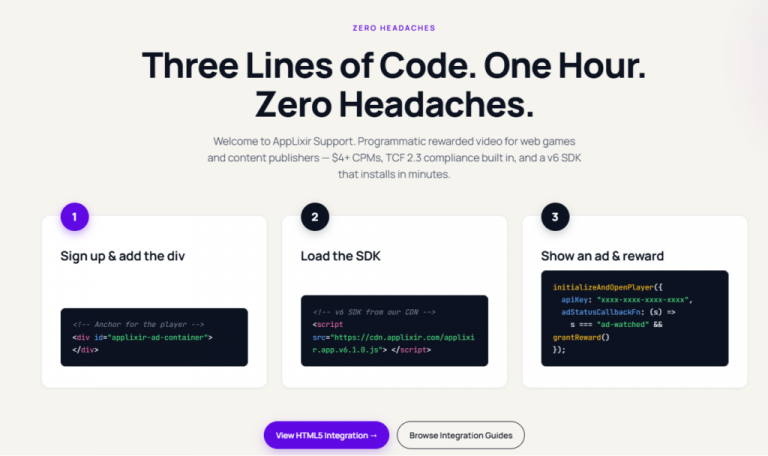
Every integration is a single script tag, a call to the ad unit at the moment of need, and a reward granted only on the ad-completed event. The variable is the placement, and the placement is a product decision, not an ad-tech one.
One rule, seven applications
Strip away the genres and the seven games follow the same rule. The offer appears at the point of need when the moment a player is blocked and motivated. A zero balance in a slots session. A failed stage in an RPG. A locked rim in a parts catalog. The next chapter of a story. The reward removes the block in thirty seconds, and the player returns to what they were doing.
The technical side does not vary much. Every integration is a single script tag, a call to the ad unit at the moment of need, and a reward granted only on the completion event. Consent handles a built-in TCF CMP. None of the seven rebuilt their game, ported a mobile SDK, or touched their render loop.
What does vary is the thinking behind the placement. Hero Wars instruments three spots so it can compare them. Royal Lounge places one offer at one moment and lets frequency do the work. Scopely treats reward integrity and supply-path transparency as the actual deliverable. Each studio answered the same question for its own players: when does someone want the reward badly enough to trade thirty seconds for it?
If you are running a web game, that is the question to answer before anything else.
About AppLixir: AppLixir is a programmatic rewarded video ad platform built for web games. It supports HTML5, WebGL and Unity Web builds, includes TCF-compliant consent management, and goes live in about 24 hours.
The post Rewarded Video Ads in Web Games: 7 Live “Best” Examples appeared first on AppLixir – Rewarded Video Ad Monetization.