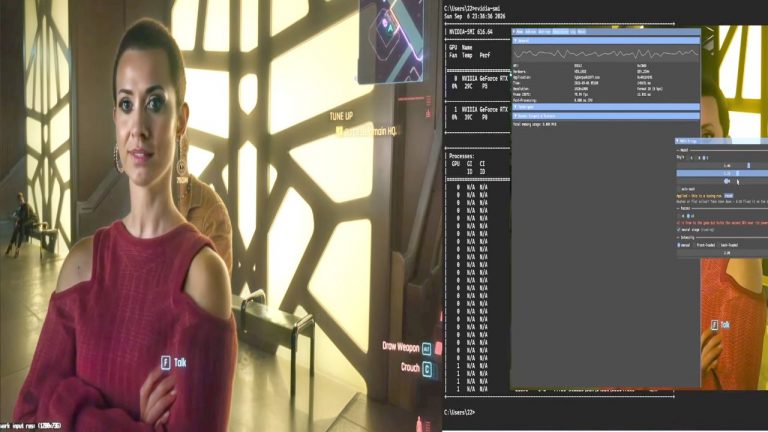
To showcase the introduction of neural rendering technologies in its next-gen mobile GPU architecture, Arm has teamed up with game studio Sumo Digital and recently dropped a short video of it in action. With ray-traced graphics, AI-denoising, and frame generation, the demo suggests that there’s a better home for the tech than a humble phone: handheld gaming PCs.
Using Unreal Engine 5.6, along with its Megalights feature, Neural Dawn will eventually be released as a complete, albeit very short, game later this year. But 120 minutes of gameplay is fine when you consider that it’s really just an interactive tech demo, showing what Arm’s neural rendering is capable of more than anything else.
Specifically, it’s highlighting two things: Neural Super Sampling and Denoising (NSSD), and Neural Frame Rate Upscaling (NFRU). The former is Arm’s equivalent to Nvidia’s DLSS Ray Reconstruction, and the latter is akin to DLSS Frame Generation.
Of course, we’ve had this tech on gaming PCs for a few years now, with frame gen first appearing with DLSS 3 in 2022, and ray reconstruction following it in 2023’s DLSS 3.5 update. Getting all this onto a phone is certainly impressive and should help such devices run even more complex graphics in the future.
But I wonder if this isn’t the best platform for it all, given the increased attention that Windows on Arm has been receiving of late. It could be argued that handheld gaming PCs would actually be better served by switching to mobile phone hardware, rather than using laptop-based APUs.
After all, high-end phones sport displays that make those in the best handheld PC’s look basic in comparison, so it’s not like mobile GPUs aren’t capable of handling the resolutions that the ROG Xbox Ally X or Legion Go S use. In a larger form factor, phone processors can run at higher frequencies for longer, as demonstrated by the Apple MacBook Neo, which is essentially an iPhone 16 Pro in a laptop shell.
(Image credit: Intel)
Nvidia might not be interested in stepping into the handheld market just yet, but Intel certainly is, so perhaps there is scope for an enterprising portable PC vendor to try something different and go 100% Arm, rather than sticking to one of AMD’s much-favoured APUs or Intel’s new chip.
However, I suspect hardware isn’t the barrier to this transition ever happening, but rather having game developers fully onboard with coding for yet another set of rendering technologies. After all, AMD’s FSR 4 isn’t supported anywhere near as much as Nvidia’s DLSS 4 is, and when it comes to Intel’s XeSS, it’s almost like developers have never even heard of it.
It would be great to have a handheld gaming PC that’s not just super-powerful, but also highly power-efficient, using hardware that’s truly designed to be mobile. Unfortunately, for as long as the RAMpocalypse continues to rage, the economy of such a venture wouldn’t make sense, and until it’s all over and things go back to normal (assuming they ever will), it’ll be a long time before we see a 100% Arm handheld PC throwing ray-traced graphics all over the place.