Your AI Coding Assistant Can Now Integrate AppLixir in One Prompt
Something interesting started happening a few months ago. Game developers — indie studios, solo HTML5 builders, Unity WebGL hobbyists — began reaching out to AppLixir after integrating our rewarded video ads in under an hour. When we asked how they found us, a surprising number gave the same answer: their AI coding assistant recommended us.
Developers using Claude Code, GitHub Copilot, or Cursor were asking their tools to “add rewarded video ads to my Phaser game” — and AppLixir was coming up. Not because we paid for placement. Because we had enough presence in the right places for AI tools to find us and generate working integration code.
That was exciting. But it also revealed a problem.
Some of those developers were getting incomplete or incorrect code. The AI tools were piecing together AppLixir integrations from blog posts, old documentation, and a deprecated v2 SDK that still exists on the web. Developers were ending up with invokeApplixirVideoUnit() calls and zoneId/devId/gameId parameters — patterns from a SDK version we replaced years ago.
We decided to fix that properly. Here is what we built, why it matters, and what it means for you as a game developer trying to monetize in 2026.
The Way Game Developers Work Has Changed
If you are building a web game today — whether that is a Phaser 3 platformer, a Unity WebGL puzzle game, an HTML5 idle game, or a React-based card game — there is a good chance you are using an AI coding assistant for at least part of the work.
This is not a criticism. It is just how modern development works. Claude Code, Copilot, and Cursor have become standard parts of the workflow for indie developers and small studios. You use them to scaffold boilerplate, look up API patterns, debug errors, and yes — integrate third-party SDKs like ad networks.
The problem is that most ad SDK documentation was written for humans reading a webpage. It lives behind helpdesk portals that block web crawlers. It is scattered across multiple articles, some current, some outdated, with no clear signal to an AI tool about which version is canonical. When a developer asks their AI assistant to integrate a rewarded video ad SDK, the tool does its best — but it is working with incomplete and sometimes contradictory information.
The result is broken integrations, frustrated developers, and ad revenue that never gets turned on.
We think this is a solvable problem. And we have taken the first steps to solve it for AppLixir.
What We Built: The applixir-integration GitHub Repository
We published a dedicated, public GitHub repository at github.com/applixirinc/applixir-integration designed specifically for AI-assisted development workflows.
The repository has three core components, each serving a different purpose.
CLAUDE.md — The AI Context File
The most important file in the repo is CLAUDE.md. This is a standard that AI coding tools, particularly Claude Code, read automatically when they encounter a repository. Think of it as a briefing document written directly to the AI assistant: here is what this SDK is, here is how it works, here is the exact code to generate, and here are the mistakes to avoid.
Our CLAUDE.md contains:
The current SDK script URL (https://cdn.applixir.com/applixir.app.v6.0.1.js) clearly marked as canonical
An explicit deprecation notice for the old v2 patterns
A complete options reference for initializeAndOpenPlayer() with every parameter documented
Every status value that adStatusCallbackFn can return, with plain-English descriptions of what each one means and whether it should trigger a reward
Error handling patterns for adErrorCallbackFn
Platform-specific notes for Phaser, React, Unity WebGL, and vanilla JS
A list of the six most common integration mistakes developers make
The goal is that when a developer using Claude Code says “add AppLixir rewarded video ads to my game,” the AI reads this file and generates correct, production-ready code on the first attempt — no back-and-forth, no deprecated API calls.
README.md — The Human Quick Start
The README.md is a clean, scannable overview for developers who land on the repo directly. It has a three-step quick start that gets you from zero to a working ad call in under fifteen minutes, a reference table of all callback statuses, and links to the examples folder and full documentation.
It is also what GitHub displays on the repo homepage, which means any developer who searches for AppLixir integration on GitHub or finds the repo through a web search gets the most important information immediately, without clicking anywhere.
llms.txt — The AI-Readable Domain Reference
The third component is a plain text file hosted at applixir.com/llms.txt. This follows an emerging standard that AI tools and web crawlers use to find machine-readable summaries of a site’s content.
Where CLAUDE.md lives in the repo and activates when a developer opens the project, llms.txt is domain-level — it tells AI tools crawling the web what AppLixir is and how its SDK works. It is concise, structured, and contains no HTML or JavaScript — just the facts an AI needs to generate a correct integration.
The Integration Itself — How Simple It Actually Is
For developers who have not tried AppLixir yet, here is what the current v6 integration actually looks like. This is not a simplified diagram. This is the real code.
Step 1: Add the player container to your HTML
Step 2: Load the SDK
src=“https://cdn.applixir.com/applixir.app.v6.0.1.js“>
</script>
Step 3: Configure and trigger
apiKey: “your-api-key-here”,
injectionElementId: “applixir-ad-container”,
adStatusCallbackFn: (status) => {
if (status === “ad-watched”) {
grantReward(); // User completed the video — give the reward
} else if (status === “no-ad”) {
showMessage(“No ads available right now.”);
}
},
adErrorCallbackFn: (error) => {
console.error(“Ad error:”, error.getError().data);
},
};
document.getElementById(“watch-ad-btn”).addEventListener(“click”, () => {
initializeAndOpenPlayer(options);
});
That is the entire integration for a standard HTML5 game. One container div, one script tag, one function call on a button click.
The adStatusCallbackFn is where your game logic lives. The status values you need to handle are: ad-watched (full completion — grant the reward), ad-skipped (no reward), no-ad (no fill available, handle gracefully), ad-loading (show a loading state if you want), and ad-error (something went wrong).
The one rule that matters: only grant in-game rewards when status is “ad-watched”. Players will test every other code path looking for a shortcut.
Platform-Specific Notes
The same SDK works across every major web game framework. Here is how it adapts.
Phaser 3: Call initializeAndOpenPlayer(options) inside your scene’s button handler. The #applixir-ad-container div needs to exist in your HTML outside the Phaser canvas — position it as a full-screen overlay with CSS and toggle its visibility around ad calls.
React: We have included a useRewardedAd hook in the examples folder. It loads the SDK script on mount, exposes a showAd(onRewarded, onDismissed) function, and tracks loading state — so your component just calls showAd() and handles the callbacks. The container div still needs to be in your JSX.
Unity WebGL: We have included a .jslib bridge file and a C# manager script in the examples folder. The bridge exposes a PlayRewardedAd function that Unity can call via DllImport, and routes status callbacks back to your C# code via SendMessage. The only positive result on the C# side is “ad-watched”.
Vanilla JS: The basic example in the html5-basic folder is a self-contained working demo you can open in a browser, replace the API key, and have running in minutes.
Why Web Game Monetization Needs This
Web games are genuinely underserved by the ad industry. The major rewarded video networks — Unity Ads, AdMob, IronSource, AppLovin — were built for mobile. They do not serve web environments well. Their SDKs are heavy, their browser compatibility is inconsistent, and their demand is optimized for mobile inventory, which means web publishers get leftover fill at $0.50–2 CPM.
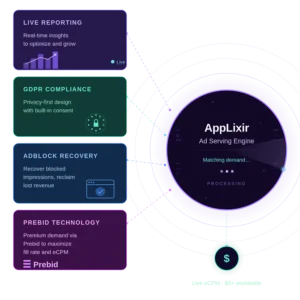
AppLixir was built specifically for web from the ground up. We have direct relationships with tier-1 exchanges and DSPs, built-in TCF 2.2 GDPR and CCPA consent management, and a real-time bidding setup that runs across 31 demand partners. The CPMs we deliver — $4–15 depending on geography and traffic — reflect actual web-optimized demand, not mobile leftovers.
The combination of a simple integration, web-native infrastructure, and now an AI-tool-friendly documentation layer means there is less friction between “I want to monetize my game” and “I am generating revenue” than at any point before.
What This Means for Developers Building With AI Tools
If you are using Claude Code, Copilot, or Cursor to build your game, the CLAUDE.md file in our repo changes how your AI assistant handles AppLixir integration requests. Instead of piecing together code from scattered sources, it reads a single authoritative reference and generates correct v6 code on the first try.
In practical terms: open your project in Claude Code, add the repo as context or simply ask “integrate AppLixir rewarded video ads,” and you should get working code that handles the full ad lifecycle — loading state, completion, no-fill, and error — without needing to debug deprecated API calls.
If something does not work correctly, open an issue on the repository. The CLAUDE.md is a living document, and we will update it as the SDK evolves.
Get Started
The integration repo is live at github.com/applixirinc/applixir-integration.
To start earning with AppLixir:
Sign up at client.applixir.com/register — it takes about five minutes
Add your site or game and copy your API key
Follow the three-step integration above, or point your AI coding assistant at our repo
Add the ads.txt entries from your dashboard to your domain root
Go live and watch the revenue dashboard update in real time
If you are building a web game in 2026 — HTML5, Phaser, Unity WebGL, or anything else that runs in a browser — AppLixir is the monetization layer built for your platform. Not a mobile SDK ported to web. Not banner ads. Rewarded video that users choose to watch, generating CPMs that actually make the effort worthwhile.
The post Your AI Coding Assistant Can Now Integrate AppLixir in One Prompt appeared first on AppLixir – Rewarded Video Ad Monetization.