Weeks after my visit to Bit Reactor, I can still distinctly remember every mission from my four and a half hours of hands-on time. It nails the XCOM specialty of combat that leaves you with stories, like when I used Jedi Padawan Tel-Rea Vokoss to force pull a guy into an exploding barrel, blowing up him and a bunch of his friends.
My greatest tactical coup? Laying down a ton of suppressing fire on an enemy spawn just as a droideka (those guys with the bubble shields) entered the picture. He needed a turn to set up, and my team chunked most of his health bar before he could manage, transforming what was supposed to be the hardest encounter of the day into a cakewalk.
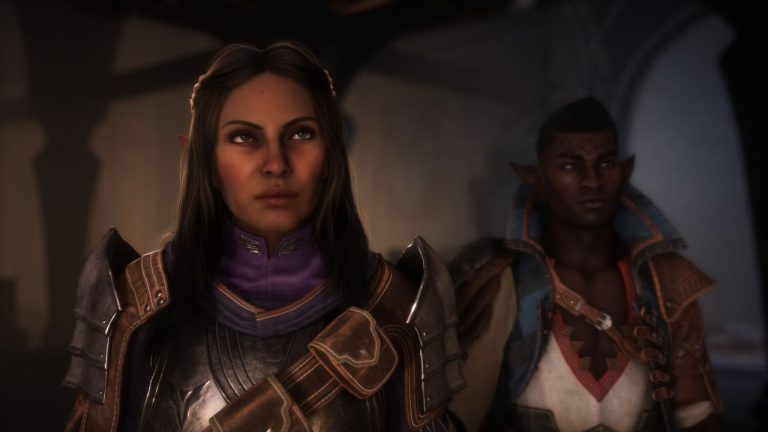
That’s what I was expecting and fans are demanding of Zero Company. What surprised me is everything else. Insane production values, for one—everything looks sumptuous and expensive, while close collaboration with Lucasfilm has resulted in an authentically Star Wars aesthetic.
And Zero Company offers the perspective to help appreciate it: Outside combat, you have full third-person action-adventure control of your customizable point-of-view character, Hawks. Before the fighting starts, you could be forgiven for thinking this is an action spinoff of Respawn’s Jedi: Fallen Order. In addition to being a great tactics game, there’s a lot of chew here for fans of RPGs, or even just someone looking for a top of the line, well-told Star Wars story.
Axe to grind
Bit Reactor founder Greg Foertsch was art director on the rebooted XCOM series as well as Marvel’s Midnight Suns, and he brought a lot of ex-XCOM talent with him: Zero Company lead producer Caydence Funk, animation lead Hector Antunez, technical director Ryan McFall, and lead designer for missions James Brawley are just the ones I’ve spoken to.
“I’d left Firaxis after about 22 years of working there and making strategy games my whole career,” Foertsch told me. “I knew I wanted to stay in the strategy, the tactics space.” His work took a dramatic turn after a fateful phone call.
“I’m sitting in my office with the lights out and my computer on, my wife’s asleep, my kids are asleep, and the phone rings. It’s this number that I don’t recognize,” Foertsch recalled. “For some reason I answered it, and the voice on the other end said, ‘Hey, Greg, this is Vince Zampella. I heard you have a game you want to make. Can you tell me about it?'”
Thus began a dialogue between Foertsch and Zampella, the highly regarded creator of Call of Duty and founder of Respawn, who tragically died in a car accident last December. Foertsch had effusive praise for Zampella, a “titan of the industry” who would ultimately hand Bit Reactor its shot at the Star Wars license.
“He eventually said, ‘Do you think you can make a Star Wars game with this?'” said Foertsch. “And I said, ‘Sure, different game, but yeah, absolutely.’ Meanwhile, I’m thinking, ‘This is insane, right? Like, this is crazy. It’s Star Wars.’ And so I said, ‘Yeah, I can do that.’ And Vince was just like, ‘Pitch me.'”
Lucasfilm, EA, Bit ReactorLucasfilm, EA, Bit ReactorLucasfilm, EA, Bit Reactor
The pitch landed with Zampella and ultimately Lucasfilm, and it was easy to see why during my visit. Foertsch is a convincing speaker who clearly loves this style of game, and he has an explicit thesis as to what the genre needs to grow, something he called his “axe to grind” with turn-based tactics.
“The gameplay is what it is about,” argued Foertsch. “But depth doesn’t cost you elegance. You can absolutely have [graphics and storytelling], and not to mention, this genre in particular, you should have those things.” He pointed out that, theoretically, you could turn off all of Zero Company’s cinematic camera work, look at the action entirely from a birdseye view, and it would technically still have the same gameplay—but it wouldn’t feel anywhere near as good.
This is a big part of why Foertsch and designer James Brawley think that formerly “dead,” PC-centric genres have been coming back: They present themselves better. They’re more approachable. Games that largely failed to make the jump from PC to console 25-30 years ago—like turn-based tactics and CRPGs—now look and feel great whether they’re played on desktop, home console, or handheld.
(Image credit: Lucasfilm, EA, Bit Reactor)
The devs I spoke to characterized Zero Company’s combination of third-person exploration with tactical combat as one of Foertsch’s main priorities in development, and it came through during the hands-on. Both styles of gameplay—tactical battles and exploration—were executed at the highest level of quality, something animation lead Hector Antunez characterized as a tightrope balancing act.
Animation, art, and level design all have different, sometimes conflicting demands at a zoomed-out, tactical view versus an intimate, action game one. “We pick our battles,” said Antunez. “The heart of the game is in the tactical combat. But we really wanted to add an element that allowed players to spend even more time in the Star Wars environments and not have those spaces be limited by what would make for fun combat.”
Drop zone
If you’ve played XCOM previously, Zero Company will feel like slipping on a favorite pair of jeans. The camera (including cinematic kill shots), cover, accuracy, and traversal all clearly iterate on the devs’ prior work at Firaxis.
You’re typically in control of a squad of four, who have three action points per character per turn, with movement requiring an AP spend depending on distance, and certain abilities demanding more than one point. Your entire squad has a shared pool of “advantage” points earned by attacking enemies, and they can be spent on special abilities independent of AP. Each class has an ultimate that demands a big advantage spend—a triple shot for the vanilla Assault class, or a rocket launcher blast for the Heavy—but there are also smaller abilities that draw on the same pool. Hawks, for example, can spend a little bit of advantage to refresh one AP for a squadmate, once per turn.
(Image credit: Lucasfilm, EA, Bit Reactor)
I got to play some early story levels, as well as a few side missions. The side stuff felt very classic: Single zones with objectives like enemy elimination, hostage rescue, or holding a capture point. All of the side missions were hand-designed, with the only procedural elements being the specific enemies that spawn, depending on where you’re at in the main story.
My greatest challenge of the day was on a side mission: I overextended myself to rescue a hostage without eliminating enough enemies first, triggering reinforcements to spawn while my team was scattered all over the map. I managed to evacuate out of there with two squadmates downed in the pickup area, a victory I can mostly attribute to the support/crowd control-focused astromech droid I brought along.
I stumbled into a slugfest with a hulked-out cultist tanking my entire crew.
The story missions were significantly more complex, boasting multiple separate combat encounters connected by segments of third-person exploration. I spent most of my time fighting battle droids and Star Wars’ cantina-loving criminal element, but my final story mission of the day introduced the force-empowered shock troops of the main bad guys.
They have this nasty trick where, if you kill one, their spirit floats off to buff a friend. The ghost power bonus stacks with each kill until a recipient goes berserk, basically transforming into a boss. Smart play would involve managing these enemies’ health bars to make sure only a weakened one is positioned to go berserk. Not knowing this ahead of time, I stumbled into a slugfest with a hulked-out cultist tanking my entire crew. Mad respect to that guy, RIP.
I saw indications of even more curveball enemy design like this later in the game—the Separatist commando droids look primed to be tough customers—but there’s a calculated deviousness to how Zero Company deploys even the most basic enemies. Dug-in overwatch points, truly inhumane flanking reinforcements, the challenges felt well-proportioned to the powerful new abilities on offer.
Mother Base
Back at your home base, the Den, all of the classic videogame clubhouse activities are on offer: Talk to your buds, buy new stuff, level up, make upgrades, et cetera. In addition to the fleshed-out story characters, you can recruit and customize hired mercenaries, allowing for the full squad construction and more emergent storytelling of XCOM at the player’s preference.
Hawks, the authored squadmates, and your chosen randos can be respecced into any of the eight standard classes—Assault, Heavy, Sharpshooter, Scoundrel, Soldier, Gunslinger, Scout, or Medic—while there are also four more restrictive “exotic” classes. The Astromech class is unsurprisingly exclusive to the titular droids—who can be visually customized with an extensive droid builder menu—while Jedi Padawan and Mandalorian Warrior are limited to their respective story characters. That leaves one more special class Bit Reactor will reveal at a later date—or leave as a surprise in the game itself.
Zero Company’s intra-mission gameplay is underpinned by a galaxy map where you can choose between various “operations” in addition to combat missions. Every “cycle” of time will open up new missions and operations, each with a timer counting down cycles until they’re unavailable. You can perform as many operations as you have the resources for per cycle, but can only fit in one full combat mission—that’s how you end a given cycle and move time forward.
(Image credit: Lucasfilm, EA, Bit Reactor)
The ops are intelligence gathering or otherwise-non combat activities that wouldn’t fit into Zero Company’s main gameplay, and they reminded me a lot of the text-based adventure sequences from Pillars of Eternity or Owlcat’s Pathfinder RPGs.
We wanted to capture the feeling of running an intelligence unit.
Grayson Scantlebury
You’ll be faced with a problem like intelligence gathering at a cantina, with options to schmooze, bribe, or start a brawl to get what you want, each with their own tradeoffs in terms of reward and squad approval. The brawl option, for example, might result in a path-to-permadeath injury for the squaddie you select to take it on.
“We wanted to capture the feeling of running an intelligence unit,” explained lead designer for operations Grayson Scantlebury. A major system of Zero Company involves permanent enemy upgrades tied to operations: You have to choose which of two permanent power-ups you want an enemy type (like the cultists or commando droids) to have less, and embark on a mutually exclusive op to make sure they don’t get it. If you ignore the operations completely, well, then they get both upgrades.
It sounds like some operations will form their own ongoing side stories. “I helped this guy. And then 10 cycles from now, he comes back with some information or an item or something that’s useful to me,” Scantlebury offered as an example. “Versus, I shot him, and he comes back, and now I’ve got a thing on the map that is not great for me.” The ones I saw always had a bit of Star Wars and storytelling flair—one op would have Zero Company covertly helping Beast Hunters on Onderon, a major location from the Clone Wars show, Tales of the Jedi comics, and Obsidian’s cult classic Knights of the Old Republic 2.
“I’ve spent a lot of time poring through books or going on Wookieepedia and going, ‘OK, I have a story I want to tell. What’s a planet that makes sense during the Clone Wars era that I could tell that story,'” said Scantlebury. “Or vice versa: I’m just browsing through and going, ‘Well, what happened on Bespin at this time, or Lothal at this time?'”
Clones ‘n clankers
Zero Company’s story is headed up by Aaron Contreras, who was narrative lead on Respawn’s Jedi: Fallen Order and its sequel, Jedi: Survivor. For Zero Company, he and the writing team are drawing on Dave Filoni’s long-lived Clone Wars animated series as a main inspiration, but filtered through the grittier style of Rogue One and Star Wars’ recent streaming TV renaissance.
Customizable protagonist Hawks is fully voiced, with sex, gender, and even a number of Star Wars species like Twi’lek and Mirialan on the table. Hawks is reminiscent of Midnight Suns’ protagonist, or the “tactician” characters in various Fire Emblems, in that they’re supposed to represent you directing the squad, but they are also a unit on the board—Hawks is the lone exception to Zero Company’s strict permadeath. If they go down, it’s just game over.
Hawks was a non-clone, non-Jedi Republic officer left holding the bag after a military blunder, leading them and their clone consigliere, Trick, to strike out on their own and form the titular Zero Company. Shortly after the game’s start, this Star Wars A-Team gets recruited by a boy scout Republic intelligence officer and a dispossessed noblewoman to investigate a freaky, Separatist-aligned Dark Side cult.
(Image credit: Lucasfilm, EA, Bit Reactor)
By far the most exciting thing for me story-wise is Zero Company’s characters and the friction between them. The cast is primed to produce memorable dust-ups like the one between Legion and Tali in Mass Effect 2, or Shadowheart almost killing Lae’zel in Baldur’s Gate 3. These are likable characters with irreconcilable differences you have to navigate.
In the Clone Wars show, the planet of Umbara was a brutal guerilla quagmire for the Republic, which makes for a lot of bad blood between your clone buddy, Trick, and Umbaran sniper Luco Bronc. These relationships will all have a mechanical element as well: There is a bond system you have to manage between the members of your squad and yourself.
Squadmates form bonds by going on missions together, so even natural enemies like Trick and Luco can be forced to overcome their animosity and work together—very Star Wars—while your choices impact your own approval ratings.
She talks like the Star Wars version of a Communist kicked out of the party for being too annoying.
By far my favorite character was Runa Blask, one of your advisors at the Den. Runa is a dyed-in-the-wool Separatist partisan, forced out by internal politicking. She talks like the Star Wars version of a Communist kicked out of the party for being too annoying.
She’s constantly sniping at you for your Republic sympathies, each interaction an opening for a lecture about their expansionist, imperialist ways. In one scene, she straight up told Hawks that her time with the Separatists made up the best days of her life, and Zero Company was a huge downgrade. She’s awful. I love her.
Permanent consequences
Permadeath, a signature staple of the XCOM games, takes on a lot more weight in Zero Company. Everyone aside from Hawks can die on a mission, and the story will keep going without them. Thankfully, it’s not curtains the second somebody goes down: They sustain “injuries” that persist between missions until you pay for treatment, culminating in that permadeath. There’s a risk-reward element to reviving someone mid-mission to help out—they could easily sustain more injuries—or taking them off the injured reserve list too early.
If you push things and Trick eats one too many blaster bolts out there? Poor guy’s headed to the big Kaminoan arcology in the sky. And while no one will leave Zero Company based on their approval rating dropping too low, Contreras confirmed that there would be story moments where your choice could drive someone away as a “specific, authored thing.”
(Image credit: Lucasfilm, EA, Bit Reactor)
He characterized permadeath as something he was hesitant to take on at first. “It was a challenge that we embraced midway through production,” Contreras recalled. “About 13 months ago, I lost an argument about permadeath, and it was good that I did, it was the right decision for the game.” As for the challenge of implementing it? “It just became a matter of rolling up our sleeves and getting to it.”
In addition to permadeath being a genre hallmark, Foertsch feels it’s thematically crucial to Zero Company. “Star Wars is about loss,” he argued. “I mean, four years old, watching Obi-Wan Kenobi die, right? It’s about loss, and then also, as a developer, wanting people to not save scum, but to push through the loss, to what’s on the other side of the experience, to feel it.”
(Image credit: Warhorse Games)
2026 games: Upcoming games
Best PC games: All-time favorites
Free PC games: Freebie fest
Best FPS games: Finest gunplay
Best RPGs: Grand adventures
Best co-op games: Better together
Zero Company doesn’t yet have a release date, but it’s slated to come out this year. The game seems on track for that; some placeholder elements and visual bugs aside, it looked almost ready for prime time with most of 2026 left to go. I think it’s going to be a contender: Going back to Foertsch’s thesis, it doesn’t feel like any tactical or strategic depth has been sacrificed in Bit Reactor’s pursuit of storytelling and presentation.
“We’re a brand new studio, and while we have a strong pedigree in the space—there’s almost 20 of us that have worked together before, so we’re not really a garage shop—we’re a new studio,” said Foertsch. He praised Respawn and Lucasfilm for choosing to “believe in trying something different and giving their audience something new,” despite both lacking experience in the tactics space. “I think that’s worth mentioning. It’s just not common anymore.”