(Image credit: Future)
Check out more of the year’s best tech in our PC Gamer Hardware Awards 2025 coverage.
I always love a new GPU year. When a whole new generation of graphics cards is going to drop, it energises the entire PC gaming hardware industry; people are going to upgrade, new laptops will arrive, and companies will refresh their entire PC lineups. It’s big. Which is why it was a real shame that the launches of both AMD and Nvidia GPUs this year were such a nightmare. Issues with drivers, hardware, and above all, pricing and availability made it hard to enjoy the thrill of new gaming tech.
So, in a mess of a launch, who gets the nominations for the best graphics card of 2025? Well, thankfully the rest of the year took care of the failures of launch time, with all the new GPUs becoming far more affordable and far closer to MSRP (in some cases even below!), and now widely available, too.
Just in time for the RAMpocalypse to strike and push prices up on anything that has any little bit of memory inside it. Hint: that means everything.
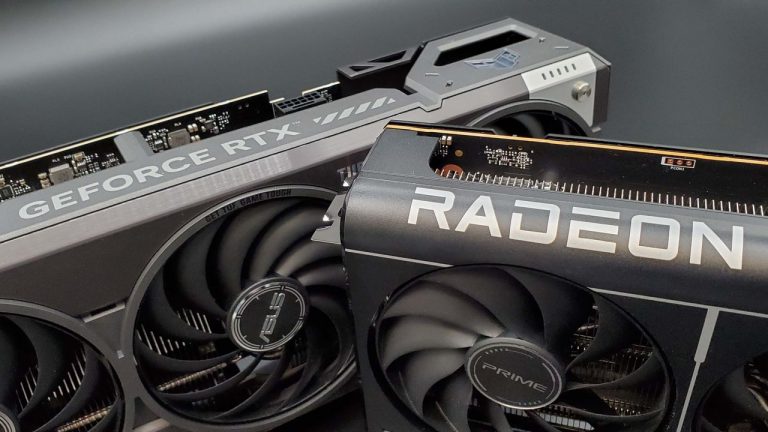
Whatever, the graphics cards of 2025 still represent the best of AMD and Nvidia’s respective architectures, and if you want the finest GPUs, these are they. And it’s been great to see AMD actually taking the fight to Nvidia properly, being aggressive on both pricing and specs, and finally competitive on both ray tracing and, with the new FSR Redstone update, their new machine learning based upscaling technology.
The Radeon RX 9070 XT isn’t making a play for the top of the stack, ultra-enthusiast segment, but the whole RX 9000-series shows AMD focusing on where most gamers spend their cash, in the mid-range.
That’s most evident in the Radeon RX 9060 XT, which followed it. That’s the most affordable card if you really need 16 GB VRAM, and delivers impressive 1440p gaming performance for the money.
Then we have the GeForce RTX 5070 Ti, again not the top of the GPU stack, but an impressively performant graphics card that can really take an overclock and then almost make an RTX 5080 look silly.
Best graphics card 2025: the nominees
AMD Radeon RX 9070 XT
Finally AMD hit on to something: Make a well-performing graphics card that can compete with Nvidia’s, but put it on sale for less than the competition. Seems like a simple, almost obvious formula, but it’s not something the red team had tried to great effect in modern times.
Some folk were concerned when they heard AMD was focusing the RX 9000-series on the volume segment of the market rather than trying to take on Nvidia at the high end. But then the RX 9070 XT came out, delivering RTX 5070 Ti performance but with a $599 price tag versus the $750 GeForce card.
Of course, it didn’t quite work out like that at launch, with both cards retailing for far more than their respective MSRPs. We saw RX 9070 XT and RTX 5070 Ti GPUs both retailing for $900+ post launch, and with prices being equal, the Nvidia card would get the nod.
Thankfully, that’s changed, and with both down to their MSRP levels consistently (for now), the Radeon is the smart pick for a high-end GPU that can now deal with both ray tracing and, in FSR4 (now just known as FSR), has far better upscaling and frame gen than previous AMD GPUs. AMD’s finally played a blinder.
Read our full AMD Radeon RX 9070 XT review.
AMD Radeon RX 9060 XT 16 GB
Carrying on AMD’s RX 9000-series task of bettering Nvidia’s competing cards for less, the RX 9060 XT took that ethos to the mid-range of the GPU market, delivering almost RTX 5060 Ti-level performance for less than the price of the deficient 8 GB version of Nvidia’s mid-range card.
Compared to the RTX 5060, though, it was all over at launch. With the Nvidia card costing $50 less, with half the VRAM and lower performance, the AMD card was the smart buy. At its MSRP, this is absolutely the cheapest way to future-proof your rig with a surfeit of video memory. Hell, even at today’s slightly inflated prices, it’s still the cheapest 16 GB card you can buy.
Now, with just $50 between the 16 GB RTX 5060 Ti and equivalent RX 9060 XT, it’s a bit more of a tougher fight, but again, AMD has proven that it can ably compete at this level, and an RX 9060 XT will get you fantastic 1440p gaming performance for a great price.
Read our full AMD Radeon RX 9060 XT review.
Nvidia GeForce RTX 5070 Ti
The RTX 5070 Ti is probably my favourite of all the RTX Blackwell GPUs, despite the fact that it was immediately put in its place upon launch by the mighty Radeon RX 9070 XT, launching theoretically $150 cheaper, but with similar levels of gaming performance.
Prices evened out pretty quickly as both were victims of low availability and high demand, and as things get closer, the extra performance and still better overall feature set would have me siding with the Nvidia card every time.
But there is one other thing that the RTX 5070 Ti is capable of that surprised me, and probably should surprise owners of the $1,000+ RTX 5080 GPUs: overclocking. For a long time, overclocking was largely worthless in terms of actual performance gains; the past few generations have precious little headroom and show no benefits even then.
The RTX 5070 Ti and the other RTX 50-series GPUs are serious overclockers, allowing the end user to boost performance by an impressive amount without negatively impacting either temperatures or power draw.
Read our full Nvidia GeForce RTX 5070 Ti review.
The winner of the Best Graphics Card 2025 PC Gamer Hardware Award will be announced on New Year’s Eve. Which one would you want to take home?