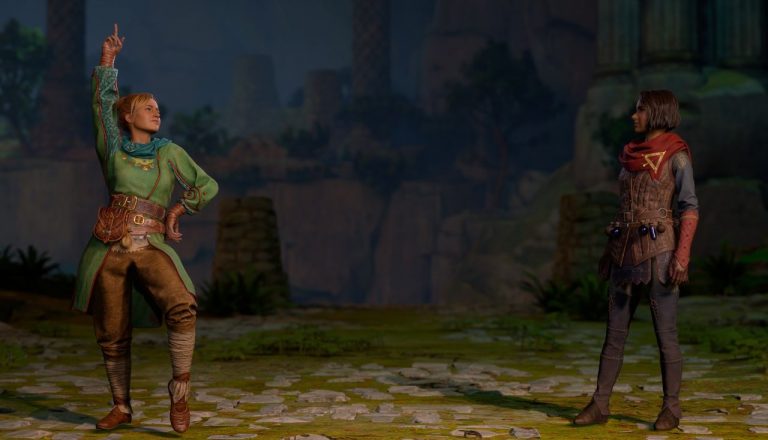
Few things show off a modern graphics engine better than a lush forest, and The Witcher 4 looks to be stuffed with them. The highly-anticipated, Unreal Engine 5-based game has dazzled in the trailers and graphics breakdowns to date, and now Nvidia has announced it’ll be using a new RTX Mega Geometry foliage system to make its trees tip-top.RTX Mega Geometry first cropped up as an Unreal Engine 5 Nanite-enhancement tool at the start of this year, allowing developers to accelerate bounding volume hierarchy building to ray trace up to 100x more triangles than previous methods.By intelligently updating clusters of triangles in batches, Nvidia claims a significantly reduced CPU overhead and much increased performance when using this method. Now, a foliage-based implementation has been announced for The Witcher 4 as part of Nvidia’s Geforce On Community Update, taking Nvidia’s performance-improving tech and applying it to the “extreme challenge” of the game’s Nanite-enhanced, supremely-dense forests.Nvidia says the tech leverages both RTX Mega Geometry and opacity micromaps. Mega Geometry partitions the top level ray tracing structure and then “selectively updates the partitions that make the most sense”. The opacity micromaps make it easier to ray trace complex, semi-transparent objects like leaves, which NV says speeds up the process considerably. It sounds like a similar process to the one used in Indiana Jones and The Great Circle, although we’ll have to wait until a talk later in the week to find out what the exact differences might be.
(Image credit: CD Projekt Red / Epic Games)
Anyway, Nvidia is promising that these two methods combined will allow for “high-fidelity, path-traced assets to run at game-ready performance”, according to the pre-briefing I attended earlier this month.Seems pretty cool to me. I can’t be the only one who wondered, upon viewing the first Witcher 4 trailer last year, how exactly the forests were going to affect performance once ray tracing was thrown into the mix. Unreal Engine 5.6’s voxel-based foliage system also looks to be evening the odds in this regard, so hopefully all those leaves are reined in a bit when it comes to GPU demands.I’m sure it’s still going to be very demanding upon release, because ray tracing almost always is. But I’ll take any performance improvements I can get, particularly if the forests end up being as lush as Nvidia showed off in its demo reel.All I can say for now is it looks very forest-y, and that the trees look to be some of the nicest representations I’ve seen in a demo reel to date. What do they look like in person? It seems we’ll have to wait until 2027 to find out. In the meantime, it’s plain old regular forest rendering for you. Shame.