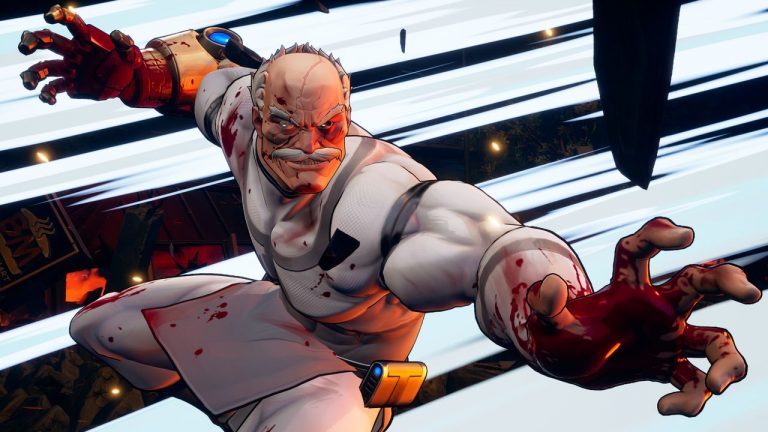
In Rémi Letam’s defense, I don’t believe he thought wandering into an active war zone in search of his parents was going to be a walk in the park. Still, I don’t think the guy deserved to end up kidnapped, tortured, and hooked up to a truth serum drip: he did save the world, after all.
What is it? A creepy action-adventure journey through pseudo-Yugoslavia
Release date: September 4, 2025
Expect to pay: $50
Developer: Rogue Factor
Publisher: Nacon
Reviewed on: Windows 11, NVIDIA GeForce RTX 2060, AMD Ryzen 9 4900HS, 16GB RAM
Steam Deck: Unsupported
Link: Official site
There’s a lot that happens before this. Hell is Us plays out as Rémi tells his story to an unpleasant representative of the Ziel Council (not the IIlluminati). He tells them about how he became an ON Peacekeeper (not UN) in Hadea (not Yugoslavia) only to break away to search for his parents, a quest that ends abruptly as he instead battles horrifying monsters called Hollow Walkers and ends the apocalyptic Calamity. A fun vacation for anyone.
As Rémi arrives in Hadea, it’s broken into civil war between the Palomists and the Sabineans, two ethnic groups that share the territory but have a long history of violence. The most recent eruption of violence has triggered the appearance of timeloops and these Hollow Walkers, or “lymbic entities,” which have occurred throughout Hadean history.
The supernatural elements are creepy and effective, but it’s the setting’s roots in our present reality that make Hadea work: legacies of ethnic conflict, religious strife, nationalist manipulation of politics, and the ineffectiveness of outside forces to interrupt the cycles of violence.
Whether Rémi is also perpetuating cycles of violence by attacking everything he sees with a large axe is up to interpretation.
Fight fire with fire
Remi’s return to Jova, his birthplace, is interrupted by civil war. (Image credit: Rogue Factor)
Remi encounters timeloops in areas where great violence has occurred. (Image credit: Rogue Factor)
Locked doors and chests can be opened with lymbic rods. (Image credit: Rogue Factor)
(Image credit: Rogue Factor)
(Image credit: Rogue Factor)
You can always count on a Feral Walker to ruin your day. (Image credit: Rogue Factor)
There were a few games last year that we didn’t have time to review, so we’re kicking off 2026 by rectifying some of those omissions. Sorry we’re late!
Most of Hell is Us is combat. There are three separate systems by which to kill: traditional combo- and parry-based melee combat, drone combat, and lymbic combat, which are special powers accessible through glyphs that Rémi can attach to his weapons. Weapons and armor can be upgraded, as can glyphs and drone modules, and Rémi also has space for a passive and an active relic that further modify his behavior. For the most part this range of different systems feels distracting because there are only five different enemy types in the game.
Sometimes those enemy types are modified by bulbous offshoots of lymbic energy that need to be destroyed before the actual enemy will take any damage, but you still spend the game fighting basically the same things the entire time. There are two (2) actual boss battles. The first one I encountered felt so out of place that I thought my game had glitched.
Combat itself is satisfying when you get into a flow: I stuck with twin axes through most of the game, and getting the hang of sending my drone off to distract while hammering a lymbic stun ability was enough to float through most battles. The clever healing mechanic based on how many hits you can land in a row meant that even tougher fights never feel too brutal. But the lack of enemy diversity meant I rarely had any tactical reason to explore my skills. Once I knew how to approach every enemy, fights depended mainly on timing and luck.
This isn’t helped by the fact that Hell is Us frontloads its weakest levels. Early areas are meant to be returned to, so there’s some sense to the simplicity of their structure, but it also means the parts of the game that you’re spending the most time in are the least interesting. Repeatedly fighting the same five monsters on the same flat patch of land never feels rewarding, just boring. Theoretically this is an incentive to close the neighboring timeloop, ensuring that you’ll only have to do those fights once, but in practice the timeloop mechanic is annoying too.
(Image credit: Rogue Factor)
All timeloops work the same way: after a certain number (unspecified) of “Timeloop Guardians” are destroyed, the timeloop can be entered, and Rémi’s drone drops a magical prism in the center to blow it up. Destroying a few of these is required but most are optional, and serve primarily to stop a level’s monsters from respawning. There are a few problems with how this is actually implemented. The timeloop guardians look exactly like other monsters, so you don’t know you’re facing them until after they’ve been killed.
Rémi’s guardian locator is a weird wisp of wind that isn’t particularly helpful in larger maps, where it’s most needed. You don’t know how many guardians you need to kill for a given loop, so if you’d like to close a loop you generally end up clearing the entire map, which is extremely tedious. And then, once you have killed all the guardians and entered the loop… there’s nothing to do.
There’s no boss fight, no sense of challenge to overcome to achieve the reward of closing it. You just get your drone to nuke the thing and bounce. It’s anticlimactic, and feels like a chore.
Make sure you write that weird S down
Even the Hollow Walkers don’t stop the sectarian violence in Hadea. (Image credit: Rogue Factor)
Outside of combat, Rémi spends a lot of time doing puzzles. They are everywhere. It is funny. I love the idea of an ancient society in the middle of a violent sectarian conflict whose main cultural heritage is picture matching.
The puzzles required for the main quest are easy enough to figure out as long as you pay attention to your surroundings and have a notebook nearby to jot down symbols or codes. There are secondary tasks called “Good Deeds” that are essentially smaller puzzles; they tend to have solutions that require exploration across maps, and sometimes don’t really make much sense in context (I’m still mad about a part where I could hear people screaming inside a barn and couldn’t break open the door with my big-ass sword. I had to bring a can of gasoline to an entirely different guy to sneak them out on a boat. Sure, I guess.) These tasks are optional, so it’s not too much of an issue when you miss one, but it gives Remi something to do as he’s exploring besides hack and slash.
Exploration is the main draw of the game. It forgoes traditional maps and checkpoints, but that doesn’t cause much of a problem—none of the levels are huge, and it’s hard to get lost (unless you’re in one particular mine. Fuck that mine.) As long as you’re thorough, you should have everything you need when you arrive at the place you have to go. They’re also absolutely gorgeous, and some later levels, which are more linear and focused, are genuinely excellent pieces of built storytelling.
The most impressive was the Auriga Museum, in which you descend slowly through an R&D department in a state of emergency by managing the limited power supply, and find two competing timeloops: one ancient, from the museum’s founding, and one recently established, so the museum’s researchers and the military could experiment with the lymbic entities’ potential use in warfare.
The more linear design allows Remi to experience a complete narrative, first learning about the Auriga Museum’s past as he discovers it, then seeing how it has been modernized and weaponized, and ending with the closure of the twin timeloops, the acts of violence that generated them echoing each other between hundreds of years.
Linear levels like the Auriga Museum have some of the most interesting locations. (Image credit: Rogue Factor)
Because it can be completed in one go, it doesn’t overstay its welcome, and because there’s basically only one way to navigate through it, it’s able to space out arena fights (the closest thing it has to a boss battle), harder monsters, and the timeloops in a way that feels satisfying.
The issue is that, in areas that aren’t this tightly authored, exploration exposes the shallowness of the rest of Hell is Us’s systems. The more monsters I killed, the clearer it was that the combat system only has a few tricks up its sleeve. The more puzzles I solved, the more I realized I was mostly solving the same puzzles. The maplessness and checkpointless nature of Hell is Us works against it when the linear parts of the game are the strongest. And on top of everything else, despite the fact that it’s 90% monsters and 10% story… it feels overwritten.
Less is more
(Image credit: Rogue Factor)
Hell is Us’s visual design is just too good for the lore to be shunted into multi-paragraph text dumps. NPC encounters are haunting, effective, and totally overridden by the amount of speaking-directly-to-camera-about-extremely-structured-historical-chronologies that Rémi endures. Everything that the game tells you is also shown in a better and more impactful way, but it doesn’t trust its own art to express the story. Nature, the modern buildings of Hadea, the ancient ruins, and the disruption of the timeloops and the Hollow Walkers come together to build a world that feels both real and chillingly likely.
Hell is Us didn’t need to tell me outright that Hadea’s civil war is the latest instance in a long history of exploited violence with supernatural consequences: it’s written all over the world. It is one of the only times in a game I can think of that I wanted to know less so I could imagine more.
Only the later areas in the game really let the atmosphere do the heavy lifting. You’ve got to get past 10 hours of lore dumps and repetitive enemy encounters first, but the feeling upon entering the city of Marastan, looking at the bodies and the looming monsters in their streets, and then hearing Palomist nationalist announcements echo through the dead town. “Marastan is a mistake that needs correcting,” they say, and your brain fills in the blanks. You dread the things that you later discover: that Marastan was an attempt at an integrated town, that a terrorist attack was used as an excuse for anti-Sabinian riots, that the well-intended dream of brotherhood burst into the acts of violence that lured the monsters.
These moments where Hell is Us trusts the player are incredible—they’re just few and far-between.
Almost there
(Image credit: Rogue Factor)
Hell is Us is overloaded with mechanics that it has little use for. Combat has too many options for the samey encounters, Remi’s got too many keys to match up to too many doors, and despite the emphasis on exploration, the best parts of the game are the parts that briskly move you from one place to the next.
That being said, Hell is Us’s missteps underscore the parts where the game really works. It is a gorgeous game, and parts of it have some of the most incredible level and character design I’ve seen in a hot minute. It takes itself seriously, and (absent its goofy frame narrative) treats topics of ethnoreligious conflict, nationalism, and cyclical violence with an earnestness and care I found humbling. It has a real eye for historicism and the built environment.
It can, when everything is working properly, feel extremely good to play, fluid and intuitive and sharp. It just also asks you to spend far too much time in the same uninteresting areas, with the same limited monster types, beholden to the same disappointing timeloop mechanic, waiting for the part where it gets good.